
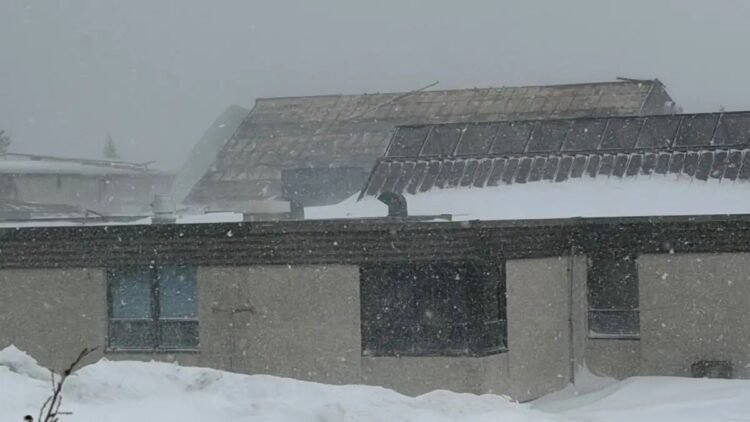
On Sunday, powerful wind gusts ranging from 80 to 121 kilometres per hour struck several regions of Alberta, causing widespread disruption. The intense winds toppled semi-trailers, knocked down trees and branches, damaged sheds, and tore shingles from rooftops. In some locations, entire sections of building roofs were ripped away due to the strength of the storm.
These extreme weather conditions impacted both urban and rural communities, leaving behind structural damage, power outages, and hazardous travel conditions.
Significant Roof Damage at Swan Hills School
One of the most notable incidents occurred in Swan Hills, located approximately 200 kilometres northwest of Edmonton. The severe windstorm tore large portions of the roof off Swan Hills School, and early assessments suggest that structural trusses may also have been damaged.
As a precaution, the Pembina Hills School Division announced that the K-12 school would remain closed on Monday. Officials stated that a comprehensive structural inspection will be conducted to confirm the building’s safety before allowing students and staff to return.
Meanwhile, the division confirmed that the school’s approximately 200 students will temporarily switch to online learning until the facility is deemed safe.
Environment Canada Issues Wind Warnings
During the storm, Environment Canada issued wind warnings covering a large portion of the province, stretching from the Alberta–U.S. border northward to Fort McMurray and across southwestern Saskatchewan.
According to Environment Canada scientist Christy Climenhaga, the severe weather was caused by a low-pressure system combined with a cold front moving across Alberta.
This system brought strong, gusty winds along with snowfall in some regions.
While southern Alberta frequently experiences strong winds, this particular weather event affected much broader areas of the province.
Climenhaga explained that many regions experienced winds near 100 km/h, with peak gusts reaching between 110 and 120 km/h in central and northern Alberta.
Highest Wind Speeds Recorded Across the Province
The strongest wind gust recorded in Alberta reached 121 km/h in Two Hills, a community located about 90 minutes east of Edmonton.
Several other communities also reported extremely high wind speeds:
- Waterton Lakes National Park: 116 km/h
- Slave Lake: 109 km/h
- Medicine Hat: 107 km/h
- Vegreville: 107 km/h
- Lethbridge: 100 km/h
- Peace River: 100 km/h
Notably, Lethbridge and Peace River, despite being nearly 1,000 kilometres apart, both experienced winds reaching 100 km/h.
Climenhaga explained that tracking wind records is difficult because strong winds occur during many different weather events, including thunderstorms, gust fronts, straight-line winds, and even tornadoes.
However, this particular storm system was a large-scale synoptic event, meaning it produced widespread winds across a broad area for an extended period.
Thousands of Homes Lose Power
The powerful winds also caused multiple power outages across Alberta.
Energy provider EPCOR reported that approximately 8,400 homes in Edmonton were without electricity at around 1 p.m., with downtown wind gusts reaching 91 km/h.
Across the city, residents discovered that strong winds had blown various items from neighboring properties into their yards. In one notable incident in West Meadowlark, an entire metal shed was blown into a residential yard.
Meanwhile, Fortis Alberta spokeswoman Tanya Croft confirmed that the fast-moving winter storm resulted in power outages affecting around 8,000 residents at different points during the day.
Croft advised residents to stay at least 10 metres away from fallen power lines and to avoid any damaged electrical equipment for safety.
Additionally, ATCO, another Alberta energy provider, reported outages in parts of northwestern Alberta.
Snowfall and Dangerous Travel Conditions
Along with strong winds, southern Alberta experienced snowfall, particularly in areas such as:
- Calgary
- Banff
- Strathmore
- Waterton Lakes
- Vulcan
- Foothills region
Weather forecasts predicted up to 20 centimetres of snow in some locations before snowfall eased later Sunday night.
The combination of high winds and blowing snow significantly reduced visibility on major highways.
The RCMP issued warnings near Airdrie, reporting that poor visibility had created dangerous driving conditions on highways including the QEII.
Police responded to multiple traffic collisions on Sunday as a result of the storm.
Another Wind System May Arrive Soon
Environment Canada indicated that another similar wind system could move through Alberta later in the week. However, meteorologists expect the next storm to be more concentrated in southern Alberta, rather than affecting the entire province.
Residents are encouraged to stay informed about weather alerts and prepare for potential high winds or snowfall in the coming days.
The powerful windstorm that swept across Alberta on Sunday demonstrated how rapidly changing weather systems can impact communities across an entire province. With wind gusts reaching 121 km/h, the storm caused structural damage, power outages, transportation hazards, and temporary school closures.
Authorities, including Environment Canada and local power companies, continue to monitor conditions and respond to storm-related issues. As another weather system may approach later this week, residents are advised to remain cautious, follow safety recommendations, and stay updated on weather warnings.